
For parents in the Burley area, few things are more stressful than watching a child melt down before a dental appointment, or worse, skipping the appointment entirely because the dread leading up to it simply is not worth the battle. Dental anxiety in children is genuinely common, and it is one of the primary reasons families delay care until a small cavity becomes a big problem. At All Smiles Dental, the team around Dr. Spencer Rice has built a practice specifically designed to make young patients feel safe and comfortable, including the ability to treat cavities in many children without injections. That one capability alone changes the experience for a lot of kids who have been avoiding the chair.
But the right dental office is only part of the equation. How parents talk about the dentist at home, what happens in the days before an appointment, and the choices made about sedation options all shape whether a child builds a healthy relationship with dental care or spends the next twenty years avoiding it.
Where Dental Anxiety in Kids Actually Comes From
Children are not born afraid of the dentist. The fear develops, and it usually comes from one of three sources: a previous painful or frightening experience, anxiety absorbed from adults around them, or simply the unknown. The sounds, smells, and physical sensations of a dental office are unlike anything children encounter elsewhere, and a child who does not know what to expect tends to fill that gap with worst-case imagination.
Parents contribute more than they realize. Research consistently shows that parental dental anxiety is one of the strongest predictors of dental anxiety in children. When a parent says things like “it will not hurt that much” or “you have to be brave” before an appointment, both phrases inadvertently signal that something painful or frightening is coming. Children are attentive to those cues, and they respond to them.
A child who had a painful experience with a previous dentist, particularly one involving an unexpected injection or a rushed procedure, often carries that association into every subsequent appointment. That is not irrational behavior. It is a learned response, and it requires active work on both the family’s and the dental team’s part to override it.
What Parents Can Do Before the Appointment
The way a dental visit is framed at home matters more than most parents expect. A few straightforward practices consistently reduce pre-appointment anxiety in children:
• Talk about the dentist in neutral, matter-of-fact terms rather than either avoiding the subject or building it up as a big deal. “We are going to the dentist on Tuesday to have your teeth checked” is more calming than either silence or elaborate reassurance.
• Use age-appropriate books or videos about dental visits beforehand. For younger children especially, familiarity with what a dental office looks and sounds like before they arrive reduces the element of surprise.
• Avoid telling children what will or will not hurt, since you cannot know, and false reassurances that prove wrong destroy trust quickly. Instead, focus on what the dental team will do to help them feel comfortable.
• Let children ask questions and answer them honestly at a level they can understand. “What if I do not like it?” deserves a real answer, not dismissal.
Scheduling appointments in the morning also helps for most children. Anxiety tends to build throughout the day, and a child who has been thinking about a dental visit since breakfast and is now hungry, tired, and anxious by a 3 PM appointment is a harder patient for everyone than a well-rested child seen at 9 AM.
Cavity Treatment Without Injections: What That Actually Means
For many children, the needle is the central fear. The anticipation of an injection, the sight of the syringe, and the sensation of the shot itself can be enough to make a child uncooperative or outright panic, which makes the entire procedure harder for everyone and more traumatic for the child going forward.
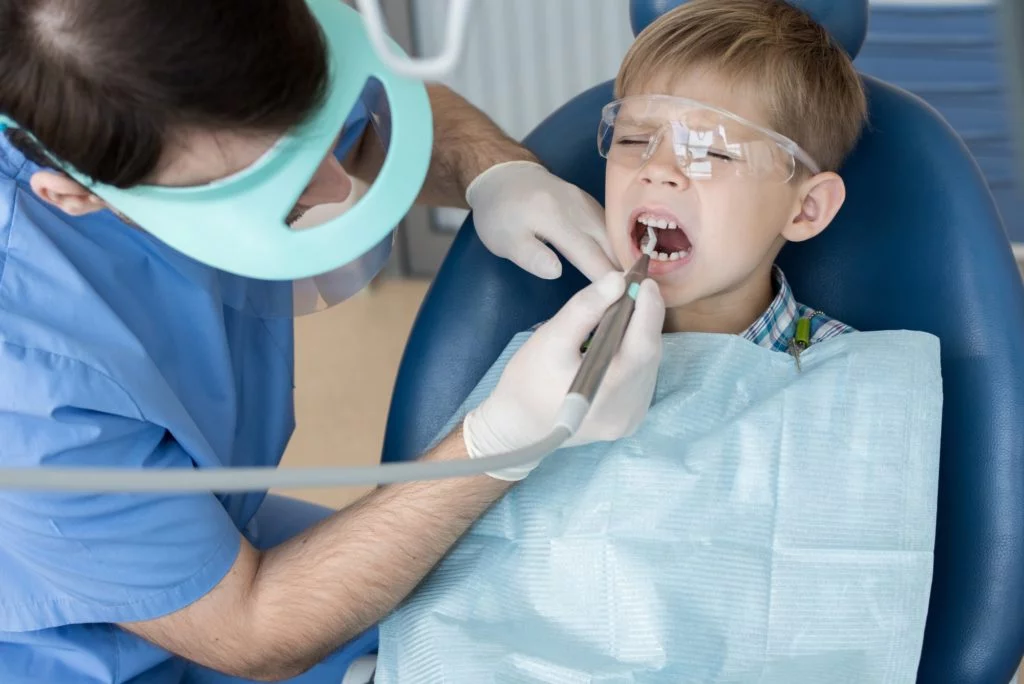
At All Smiles Dental, many cavities in children can be treated without an injection at all. This is possible when decay is caught early and involves only the outer layers of the tooth, where the nerve is not involved and the drilling depth does not require full anesthesia. Using air abrasion or careful handpiece technique on superficial cavities, Dr. Rice can often complete a filling without producing the sensation that requires numbing.
This is not possible in every situation. Deeper cavities that approach or involve the pulp of the tooth require proper anesthesia, and attempting to treat them without it would be inappropriate. But for the significant number of children whose cavities are caught at routine cleanings before they progress, the injection-free option removes the most common trigger of dental fear entirely.
Parents of children who have had bad experiences elsewhere sometimes discover at the first appointment with Dr. Rice that their child tolerates treatment far better than expected, simply because the experience is different. That moment matters. It begins to rewrite the story the child has been carrying about what dental visits mean.
Sedation Options for Children Who Need More Support
For children whose anxiety is significant enough that even a gentle, patient approach in the chair is not enough, sedation dentistry provides a path to necessary treatment without trauma. Several options are used in pediatric dental care depending on the child’s age, weight, health history, and the extent of treatment needed.
Nitrous oxide, commonly called laughing gas, is the mildest and most widely available form of dental sedation for children. It is inhaled through a small mask placed over the nose, takes effect quickly, and wears off almost immediately after the mask is removed. Children remain conscious and responsive throughout the procedure but feel relaxed, less aware of discomfort, and generally much less bothered by what is happening. It is safe for most children and does not require a period of recovery before the child can return to normal activity.
Oral sedation, where a liquid medication is given before the appointment to produce a deeper state of relaxation, is used for children who need more extensive treatment or who do not respond adequately to nitrous oxide alone. Children who receive oral sedation are drowsy and may not remember the appointment clearly afterward. They require a parent or guardian present throughout and need to rest afterward.
The decision about whether and what type of sedation is appropriate for a specific child involves a conversation with Dr. Rice about the child’s health history, weight, the extent of dental work needed, and how previous appointments have gone. Sedation is not used reflexively or as a shortcut, but for children who genuinely need it to receive care safely, it is one of the most valuable tools a family dentist can offer.
Why Multiple Small Appointments Often Work Better Than One Long One
One testimonial from an All Smiles Dental parent captures something important: the ability to treat a child’s cavities without scheduling several separate appointments. For anxious children, though, the calculus sometimes goes the other way. Spreading treatment across shorter visits, particularly when a child is being introduced to dental care for the first time after a long gap, can reduce each individual session to something manageable. A 20-minute appointment where the child simply meets the team and has their teeth counted is a different experience from a 90-minute first visit involving multiple fillings.
Dr. Rice and the team are willing to have that conversation with parents about what pacing makes sense for their child. The goal is not to maximize efficiency at the cost of the child’s long-term relationship with dental care.
Building a Dental Home at All Smiles Dental in Burley
The American Academy of Pediatric Dentistry recommends that children have their first dental visit by age one, or within six months of the first tooth appearing. Starting early, before children have any reason to be afraid, is the most effective prevention strategy for dental anxiety. Children who visit the dentist regularly from a young age in a practice where the staff knows them by name and the environment feels welcoming tend to carry positive associations with dental care into adulthood.
All Smiles Dental has built exactly that kind of environment in Burley. Families throughout the Magic Valley who have been putting off bringing in an anxious child, or who have had difficult experiences at other practices, consistently describe a different experience once they find a team that takes the time to actually help children feel comfortable.
If your child has been avoiding the dentist or if you have been putting off making an appointment because you are not sure how it will go, call All Smiles Dental to talk through what your child needs before you even schedule. The conversation costs nothing and can make the first visit a lot easier for everyone.